Oakland city
A Man in FullOakland city is a geographic hinge in Conrad Hensley’s story: it is the urban center he travels to for a possible office job, while the Oakland side of the bay also frames the industrial landscape of the Croker Global Foods warehouse where he has worked. These settings connect his physical exhaustion and unemployment to a search for another kind of labor, without making that transition easy or assured.
The industrial East Bay setting
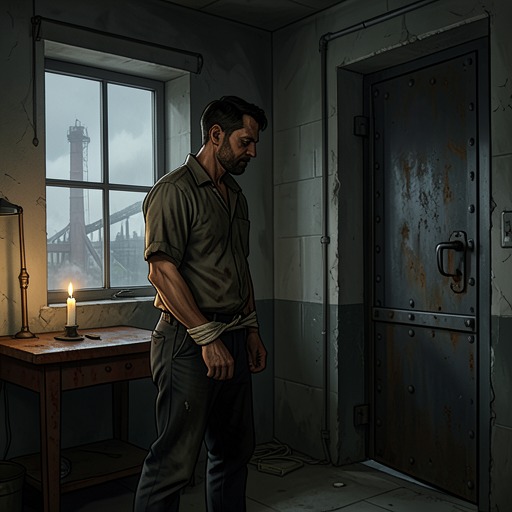
The warehouse is introduced through a deliberate contrast with the celebrated image of the San Francisco Bay Area. The passage evokes San Francisco’s fog, steep Powell Street, cable cars, and freighters, then shifts a few miles east to the heat of Contra Costa County. There, after a day that reached 104 degrees, the warehouse roof remains hot under a night sky, the temperature still near 90. The employees’ dirt parking lot is parched and pocked. The contrast places the warehouse outside the region’s picturesque public image: it belongs to the industrial hardpan that keeps the larger Bay Area running.
The narrative locates the facility on the bay’s east side, on the Oakland side and up toward El Cerrito, in Contra Costa County near the marshes. That description makes Oakland a point of orientation rather than a precise claim that the warehouse lies within Oakland city limits. The surrounding view is of infrastructure and industry: a razor-wire-topped Cyclone fence, a sewage substation, the smokestack of Bolka Rendering works, a freeway spur under construction, and aircraft approaching Oakland International Airport. The setting is defined less by a civic center than by the systems that process waste, move traffic, and support commerce.
At about 8:45 on a hot evening, Conrad drives into the warehouse employees’ lot in a Hyundai hatchback family wagon, with the air conditioning running because he is wearing long johns beneath his work clothes. He searches six or seven rows of cars, raising dust, before parking by the fence. His appearance reflects the physical demands of the job: his build is slight, but his forearms and hands have grown muscular during six months of heavy work in the freezer. Even his wedding ring has become tight against his finger. The warehouse is therefore not merely a workplace in the background; its labor has altered his body.
From warehouse labor to unemployment
For Conrad, work at the warehouse had been a way to escape the deteriorating duplex where he and Jill Hensley live in Pittsburg, about thirty miles east of Oakland. After he loses his job, that hoped-for escape reverses. His savings of $4,700 are dwindling, while the family remains in the same cramped housing. The narrative’s account of the cheap folding chair, worn rug, improvised coffee table, and children’s toys makes unemployment tangible through the domestic objects around him rather than treating it as an abstract status.
Conrad considers applying through ContempoTime, an Oakland agency that advertises for word processors in the Oakland Tribune and the Walnut Creek Observer. The agency hires clerical workers as temporary office staff for East Bay companies. He cannot afford a computer or word processor, but he has used computers at Mount Diablo College and believes he may have relevant skills. His hope is specific and limited: to exchange freezer labor for an office placement. The prospect does not erase the material pressure of unemployment, and his torn jeans and thickened work clothes remain reminders of the job he has lost.
Downtown Oakland and the employment search
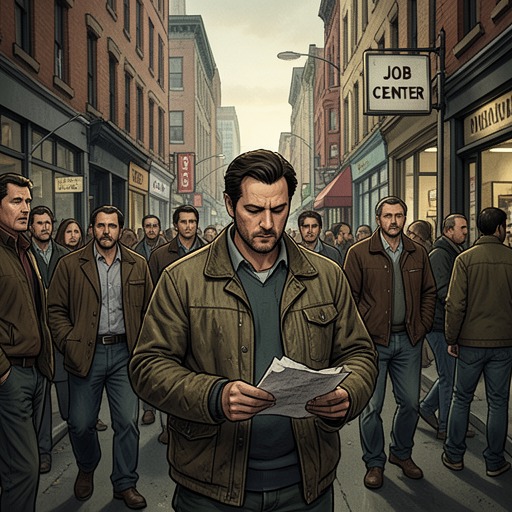
Conrad’s trip to ContempoTime turns Oakland from a distant employment center into a place of immediate practical difficulty. An accident in the Caldecott Tunnel on Route 24 causes a major backup, and he reaches downtown Oakland barely five minutes before his 10 a.m. appointment. He is preoccupied with finding parking, eventually squeezing the Hyundai into a legal space near a red-painted curb and a fire hydrant, beside a large Chevrolet Suburban. His concern with keeping the appointment contrasts with the more casual attitude toward appointments he associates with his parents.
Inside the East Bay Insurance Building, Conrad discovers that the appointment is not a private interview at a fixed time but a broad intake period. Twenty or thirty applicants sit in rows of school-style chairs, filling out forms and waiting to be assigned to interviewers. Fluorescent lights blink above the room, while electric typewriters clatter beyond the reception area in a maze of cubicles. The scene gives the job search a collective, procedural character: Conrad enters not as a singled-out candidate but as one person among a waiting group.
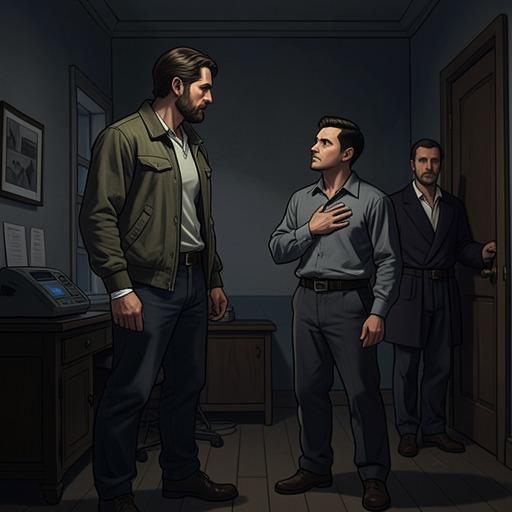
He has worn his only dress-up outfit after Mrs. Otey urged him to present himself suitably: a white shirt, tie, navy blazer, and gray wool trousers. The clothes no longer fit comfortably. His jacket is too tight, he cannot button the shirt at the neck, and his laborer’s hands extend beyond the cuffs. Even as he tries to appear qualified for clerical work, his body records the months spent in the freezer unit. The mismatch between the outfit and his changed physique makes the move into office employment visible as a difficult transition rather than a simple change of workplace.
Geographic and narrative significance
Oakland’s role in these episodes depends on its relation to surrounding places. The warehouse is described as being on the Oakland side of the bay but in Contra Costa County; Conrad’s home is farther east in Pittsburg; and the agency is downtown Oakland, reached through the congested Route 24 corridor. The locations form a connected East Bay landscape of industrial employment, inexpensive housing, and temporary-work offices. They also distinguish the celebrated San Francisco image from the hotter, dustier environment in which Conrad’s labor and job search unfold.
That geography shapes the terms of Conrad’s uncertainty. The warehouse has given him strength but not security; the agency offers a possible route into office work but initially gives him forms, fluorescent-lit waiting, and no immediate assurance of placement. Oakland is thus both the center toward which he travels for opportunity and the urban node in a wider landscape that has already left him unemployed and short of savings. Its significance lies in that unresolved passage between kinds of work, with the physical traces of one job accompanying him as he seeks another.